Public Member Functions |
Public Attributes |
Private Types |
Private Member Functions |
Private Attributes |
List of all members
xrpl::Number::Guard Class Reference
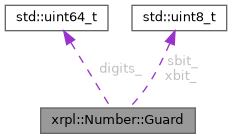
Collaboration diagram for xrpl::Number::Guard:
Public Member Functions | |
| Guard (InternalRep const &minMantissa, InternalRep const &maxMantissa, MantissaRange::CuspRoundingFix cuspRoundingFix) | |
| Guard (MantissaRange const &range) | |
| void | setPositive () noexcept |
| void | setNegative () noexcept |
| void | setDropped () noexcept |
| bool | isNegative () const noexcept |
| template<class T> | |
| void | push (T d) noexcept |
| unsigned | pop () noexcept |
| bool | unrecoverable () const noexcept |
| bool | empty () const noexcept |
| template<class T> | |
| void | doDropDigit (T &mantissa, int &exponent) noexcept |
| Drop a digit from the mantissa, and increment the exponent, storing the dropped digit in this Guard. | |
| template<class T> | |
| void | doDropDigitWithTarget (T &mantissa, int &exponent, int const targetExponent) noexcept |
| Drop a digit from the mantissa, and increment the exponent, storing the dropped digit in this Guard. | |
| template<UnsignedMantissa T> | |
| void | doRoundUp (bool &negative, T &mantissa, int &exponent, std::string location) |
| template<UnsignedMantissa T> | |
| void | doRoundDown (bool &negative, T &mantissa, int &exponent) const |
| void | doRound (rep &drops, std::string location) const |
| template<> | |
| void | doDropDigit (UInt128T &mantissa, int &exponent) noexcept |
Public Attributes | |
| InternalRep const | minMantissa |
| InternalRep const | maxMantissa |
| MantissaRange::CuspRoundingFix const | cuspRoundingFix |
Private Types | |
| enum class | Round { Exact = -2 , Down = -1 , Even = 0 , Up = 1 } |
Private Member Functions | |
| template<UnsignedMantissa T> | |
| void | pushOverflow (T mantissa) |
| Round | round () const noexcept |
| void | doPush (unsigned d) noexcept |
| template<UnsignedMantissa T> | |
| void | bringIntoRange (bool &negative, T &mantissa, int &exponent) const |
Private Attributes | |
| std::uint64_t | digits_ {0} |
| std::uint8_t | xbit_: 1 {0} |
| std::uint8_t | sbit_: 1 {0} |
Detailed Description
The Guard class is used to temporarily add extra digits of precision to an operation. This enables the final result to be correctly rounded to the internal precision of Number.
At its core, the Guard really only needs three pieces of information to determine how to round:
- The rounding mode
- The last digit dropped from the mantissa (i.e. the first digit after the decimal point). (first byte of digits_)
- Whether any other non-zero digits were dropped from the mantissa. (remaining bytes of digits_ and xbit_)
Upward and Downward rounding modes round the unsigned mantissa toward or away from zero depending on whether the sign is negative (sbit_). For positive values, Upward is away, and Downward is toward. For negative values, that's reversed. For simplicity, I'm going to describe the logic using "TowardZero" and "AwayFromZero".
TowardZero is the easiest rounding mode. It always rounds down. digits_ and xbit_ are irrelevant. AwayFromZero is almost as simple. If both "digits_" and "xbit_" are zero (0), it rounds down. Else it rounds up. ToNearest is only a little more complicated. If the last dropped digit is < 5, then round down. If it is > 5, round up. If it is exactly 5, and there are any other digits (the remainder of "digits_" or "xbit_"), round up, else round to even.
The current implementation stores 16 digits in "digits_" so that digits can be "pop"ped back out if needed during subtraction (negative addition) operations.
Definition at line 219 of file libxrpl/basics/Number.cpp.
Member Enumeration Documentation
◆ Round
|
strongprivate |
| Enumerator | |
|---|---|
| Exact | |
| Down | |
| Even | |
| Up | |
Definition at line 315 of file libxrpl/basics/Number.cpp.
Constructor & Destructor Documentation
◆ Guard() [1/2]
|
explicit |
Definition at line 230 of file libxrpl/basics/Number.cpp.
◆ Guard() [2/2]
|
explicit |
Definition at line 238 of file libxrpl/basics/Number.cpp.
Member Function Documentation
◆ setPositive()
|
noexcept |
Definition at line 346 of file libxrpl/basics/Number.cpp.
◆ setNegative()
|
noexcept |
Definition at line 352 of file libxrpl/basics/Number.cpp.
◆ setDropped()
|
noexcept |
Definition at line 358 of file libxrpl/basics/Number.cpp.
◆ isNegative()
|
nodiscardnoexcept |
Definition at line 364 of file libxrpl/basics/Number.cpp.
◆ push()
template<class T>
|
noexcept |
Definition at line 380 of file libxrpl/basics/Number.cpp.
◆ pop()
|
noexcept |
Definition at line 386 of file libxrpl/basics/Number.cpp.
◆ unrecoverable()
|
nodiscardnoexcept |
Definition at line 394 of file libxrpl/basics/Number.cpp.
◆ empty()
|
nodiscardnoexcept |
Definition at line 400 of file libxrpl/basics/Number.cpp.
◆ doDropDigit() [1/2]
template<class T>
|
noexcept |
Drop a digit from the mantissa, and increment the exponent, storing the dropped digit in this Guard.
Substitute for: push(mantissa % 10); mantissa /= 10; ++exponent;
Definition at line 407 of file libxrpl/basics/Number.cpp.
◆ doDropDigitWithTarget()
template<class T>
|
noexcept |
Drop a digit from the mantissa, and increment the exponent, storing the dropped digit in this Guard.
If a drop will not do anything meaningful (there are no recoverable digits in the guard, and the mantissa is 0), and if targetExponent > exponent, simply set exponent to targetExponent.
Definition at line 428 of file libxrpl/basics/Number.cpp.
◆ doRoundUp()
template<UnsignedMantissa T>
| void xrpl::Number::Guard::doRoundUp | ( | bool & | negative, |
| T & | mantissa, | ||
| int & | exponent, | ||
| std::string | location ) |
Definition at line 580 of file libxrpl/basics/Number.cpp.
◆ doRoundDown()
template<UnsignedMantissa T>
| void xrpl::Number::Guard::doRoundDown | ( | bool & | negative, |
| T & | mantissa, | ||
| int & | exponent ) const |
Definition at line 656 of file libxrpl/basics/Number.cpp.
◆ doRound()
| void xrpl::Number::Guard::doRound | ( | rep & | drops, |
| std::string | location ) const |
Definition at line 692 of file libxrpl/basics/Number.cpp.
◆ pushOverflow()
template<UnsignedMantissa T>
|
private |
Definition at line 447 of file libxrpl/basics/Number.cpp.
◆ round()
|
nodiscardprivatenoexcept |
Definition at line 509 of file libxrpl/basics/Number.cpp.
◆ doPush()
|
privatenoexcept |
Definition at line 370 of file libxrpl/basics/Number.cpp.
◆ bringIntoRange()
template<UnsignedMantissa T>
|
private |
Definition at line 553 of file libxrpl/basics/Number.cpp.
◆ doDropDigit() [2/2]
template<>
|
noexcept |
Definition at line 416 of file libxrpl/basics/Number.cpp.
Member Data Documentation
◆ digits_
|
private |
Definition at line 221 of file libxrpl/basics/Number.cpp.
◆ xbit_
|
private |
Definition at line 222 of file libxrpl/basics/Number.cpp.
◆ sbit_
|
private |
Definition at line 223 of file libxrpl/basics/Number.cpp.
◆ minMantissa
| InternalRep const xrpl::Number::Guard::minMantissa |
Definition at line 226 of file libxrpl/basics/Number.cpp.
◆ maxMantissa
| InternalRep const xrpl::Number::Guard::maxMantissa |
Definition at line 227 of file libxrpl/basics/Number.cpp.
◆ cuspRoundingFix
| MantissaRange::CuspRoundingFix const xrpl::Number::Guard::cuspRoundingFix |
Definition at line 228 of file libxrpl/basics/Number.cpp.
Generated by
 1.17.0