Classes |
Public Member Functions |
Static Private Member Functions |
Private Attributes |
List of all members
xrpl::Workers Class Reference
Workers is effectively a thread pool. More...
#include <Workers.h>
Collaboration diagram for xrpl::Workers:
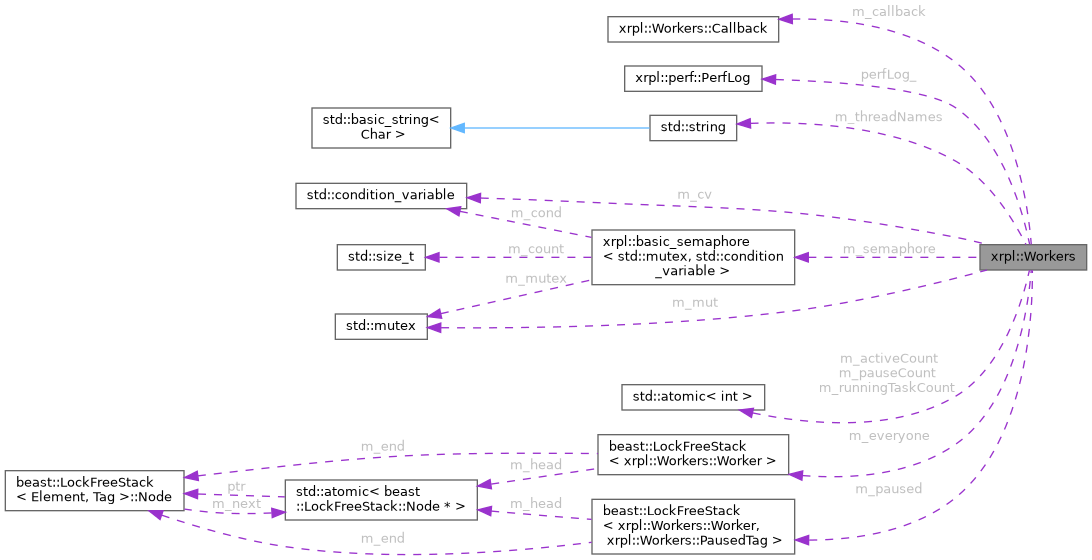
Classes | |
| struct | Callback |
| Called to perform tasks as needed. More... | |
| struct | PausedTag |
| class | Worker |
Public Member Functions | |
| Workers (Callback &callback, perf::PerfLog *perfLog, std::string threadNames="Worker", int numberOfThreads=static_cast< int >(std::thread::hardware_concurrency())) | |
| Create the object. | |
| ~Workers () | |
| int | getNumberOfThreads () const noexcept |
| Retrieve the desired number of threads. | |
| void | setNumberOfThreads (int numberOfThreads) |
| Set the desired number of threads. | |
| void | stop () |
| Pause all threads and wait until they are paused. | |
| void | addTask () |
| Add a task to be performed. | |
| int | numberOfCurrentlyRunningTasks () const noexcept |
| Get the number of currently executing calls of Callback::processTask. | |
Static Private Member Functions | |
| static void | deleteWorkers (beast::LockFreeStack< Worker > &stack) |
Private Attributes | |
| Callback & | callback_ |
| perf::PerfLog * | perfLog_ |
| std::string | threadNames_ |
| std::condition_variable | cv_ |
| std::mutex | mut_ |
| bool | allPaused_ {true} |
| Semaphore | semaphore_ |
| int | numberOfThreads_ {0} |
| std::atomic< int > | activeCount_ |
| std::atomic< int > | pauseCount_ |
| std::atomic< int > | runningTaskCount_ |
| beast::LockFreeStack< Worker > | everyone_ |
| beast::LockFreeStack< Worker, PausedTag > | paused_ |
Detailed Description
Workers is effectively a thread pool.
The constructor takes a "callback" that has a void processTask(int instance) method, and a number of workers. It creates that many Workers and then waits for calls to Workers::addTask(). It holds a semaphore that counts the number of pending "tasks", and a condition variable for the event when the last worker pauses itself.
A "task" is just a call to the callback's processTask method. "Adding a task" means calling that method now, or remembering to call it in the future. This is implemented with a semaphore. If there are any workers waiting when a task is added, then one will be woken to claim the task. If not, then the next worker to wait on the semaphore will claim the task.
Creating a Worker creates a thread that calls Worker::run(). When that thread enters Worker::run, it increments the count of active workers in the parent Workers object and then tries to claim a task, which blocks if there are none pending. It will be unblocked whenever the semaphore is notified (i.e. when the number of pending tasks is incremented). That only happens in two circumstances: (1) when Workers::addTask is called and (2) when Workers wants to pause some workers ("pause one worker" is considered one task), which happens when someone wants to stop the workers or shrink the threadpool. No worker threads are ever destroyed until Workers is destroyed; it merely pauses workers until then.
When a waiting worker is woken, it checks whether Workers is trying to pause workers. If so, it changes its status from active to paused and blocks on its own condition variable. If not, then it calls processTask on the "callback" held by Workers.
When a paused worker is woken, it checks whether it should exit. The signal to exit is only set in the destructor of Worker, which unblocks the paused thread and waits for it to exit. A Worker::run thread checks whether it needs to exit only when it is woken from a pause (not when it is woken from waiting). This is why the destructor for Workers pauses all the workers before destroying them.
Constructor & Destructor Documentation
◆ Workers()
|
explicit |
Create the object.
A number of initial threads may be optionally specified. The default is to create one thread per CPU.
- Parameters
-
threadNames The name given to each created worker thread.
Definition at line 13 of file Workers.cpp.
◆ ~Workers()
| xrpl::Workers::~Workers | ( | ) |
Definition at line 29 of file Workers.cpp.
Member Function Documentation
◆ getNumberOfThreads()
|
nodiscardnoexcept |
Retrieve the desired number of threads.
This just returns the number of active threads that were requested. If there was a recent call to setNumberOfThreads, the actual number of active threads may be temporarily different from what was last requested.
- Note
- This function is not thread-safe.
Definition at line 37 of file Workers.cpp.
◆ setNumberOfThreads()
| void xrpl::Workers::setNumberOfThreads | ( | int | numberOfThreads | ) |
Set the desired number of threads.
- Note
- This function is not thread-safe.
Definition at line 47 of file Workers.cpp.
◆ stop()
| void xrpl::Workers::stop | ( | ) |
Pause all threads and wait until they are paused.
If a thread is processing a task it will pause as soon as the task completes. There may still be tasks signaled even after all threads have paused.
- Note
- This function is not thread-safe.
Definition at line 98 of file Workers.cpp.
◆ addTask()
| void xrpl::Workers::addTask | ( | ) |
Add a task to be performed.
Every call to addTask will eventually result in a call to Callback::processTask unless the Workers object is destroyed or the number of threads is never set above zero.
- Note
- This function is thread-safe.
Definition at line 112 of file Workers.cpp.
◆ numberOfCurrentlyRunningTasks()
|
nodiscardnoexcept |
Get the number of currently executing calls of Callback::processTask.
While this function is thread-safe, the value may not stay accurate for very long. It's mainly for diagnostic purposes.
Definition at line 118 of file Workers.cpp.
◆ deleteWorkers()
|
staticprivate |
Definition at line 124 of file Workers.cpp.
Member Data Documentation
◆ callback_
◆ perfLog_
|
private |
◆ threadNames_
|
private |
◆ cv_
|
private |
◆ mut_
|
private |
◆ allPaused_
◆ semaphore_
◆ numberOfThreads_
◆ activeCount_
|
private |
◆ pauseCount_
|
private |
◆ runningTaskCount_
|
private |
◆ everyone_
|
private |
◆ paused_
|
private |
Generated by
 1.17.0