xrpl::test::RequestCountingPeerSet Class Referenceabstract
A peer set that counts the requests an acquisition makes through it. More...
#include <AcquireTestHelpers.h>
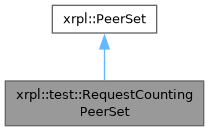
Inheritance diagram for xrpl::test::RequestCountingPeerSet:
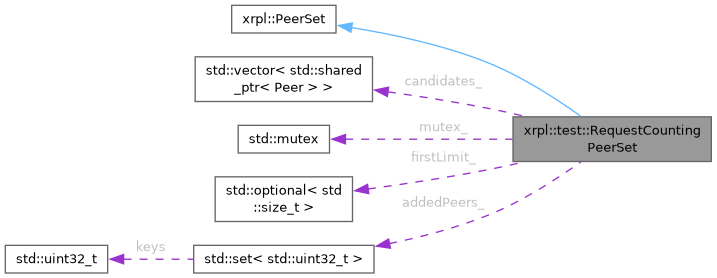
Collaboration diagram for xrpl::test::RequestCountingPeerSet:
Public Member Functions | |
| RequestCountingPeerSet (std::vector< std::shared_ptr< Peer > > candidates={}) | |
| void | addPeers (std::size_t limit, std::function< bool(std::shared_ptr< Peer > const &)> hasItem, std::function< void(std::shared_ptr< Peer > const &)> onPeerAdded) override |
| Offer the candidates to the caller, the way the real peer set offers the peers the overlay is tracking. | |
| void | sendRequest (::google::protobuf::Message const &, protocol::MessageType, std::shared_ptr< Peer > const &peer) override |
| Record the request, and record it in the broadcast count as well when it names no peer. | |
| std::set< Peer::ID > const & | getPeerIds () const override |
| The ids of every peer addPeers() has selected, which is what an acquisition takes for the peers it is tracking. | |
| int | requests () const |
| int | broadcasts () const |
| How many of those requests carried no peer of their own. | |
| std::optional< std::size_t > | firstLimit () const |
| The limit the first addPeers() call asked for, which is init()'s, since onTimer() keeps calling addPeers(1) for as long as an acquisition runs. | |
| std::set< Peer::ID > | addedPeers () const |
| A set, because onTimer() keeps re-offering the same candidates. | |
| virtual void | addPeers (std::size_t limit, std::function< bool(std::shared_ptr< Peer > const &)> hasItem, std::function< void(std::shared_ptr< Peer > const &)> onPeerAdded)=0 |
| Try add more peers. | |
| template<typename MessageType> | |
| void | sendRequest (MessageType const &message, std::shared_ptr< Peer > const &peer) |
| send a message | |
| virtual void | sendRequest (::google::protobuf::Message const &message, protocol::MessageType type, std::shared_ptr< Peer > const &peer)=0 |
Private Attributes | |
| std::vector< std::shared_ptr< Peer > > const | candidates_ |
| std::mutex | mutex_ |
| int | requests_ {0} |
| int | broadcasts_ {0} |
| std::optional< std::size_t > | firstLimit_ |
| std::set< Peer::ID > | addedPeers_ |
Detailed Description
A peer set that counts the requests an acquisition makes through it.
Offers peers to a hasItem/onPeerAdded callback pair, hard-filtered by hasItem (which only scores in the real peer set) and deduped by tracked id.
A count is a call, not a delivery: a request naming no peer reaches nobody while this set tracks none. requests() and broadcasts() are counted apart.
Every write here is guarded, since the retry timer drives addPeers() and sendRequest() from a job thread while the test reads the results.
Definition at line 128 of file AcquireTestHelpers.h.
Constructor & Destructor Documentation
◆ RequestCountingPeerSet()
|
explicit |
- Parameters
-
candidates The peers addPeers() may offer, in the order they are considered. Fixed at construction. Empty offers no one.
Definition at line 135 of file AcquireTestHelpers.h.
Member Function Documentation
◆ addPeers() [1/2]
|
override |
Offer the candidates to the caller, the way the real peer set offers the peers the overlay is tracking.
- Parameters
-
limit The most peers to add, recorded for firstLimit(). hasItem Hard-filters the candidates worth asking, where the real peer set only scores with it. onPeerAdded Called for each selected candidate.
Definition at line 150 of file AcquireTestHelpers.h.
◆ sendRequest() [1/3]
|
override |
Record the request, and record it in the broadcast count as well when it names no peer.
- Parameters
-
peer The peer to ask, or null to ask every tracked peer.
Definition at line 184 of file AcquireTestHelpers.h.
◆ getPeerIds()
|
nodiscardoverridevirtual |
The ids of every peer addPeers() has selected, which is what an acquisition takes for the peers it is tracking.
Unguarded: every caller of this and of addPeers() is an acquisition holding its own mtx_, so the ids stay fixed while a caller iterates. A test thread reads addedPeers() instead. InboundLedger::getPeerCount() reports zero for these, since it resolves ids through the overlay, while these peers live only in this harness.
- Returns
- The ids.
Implements xrpl::PeerSet.
Definition at line 208 of file AcquireTestHelpers.h.
◆ requests()
|
nodiscard |
- Returns
- How many requests have been sent through this peer set, counting a broadcast as one.
Definition at line 218 of file AcquireTestHelpers.h.
◆ broadcasts()
|
nodiscard |
How many of those requests carried no peer of their own.
- Returns
- The count.
Definition at line 230 of file AcquireTestHelpers.h.
◆ firstLimit()
|
nodiscard |
The limit the first addPeers() call asked for, which is init()'s, since onTimer() keeps calling addPeers(1) for as long as an acquisition runs.
- Returns
- The limit, or nullopt if addPeers() has not been called.
Definition at line 243 of file AcquireTestHelpers.h.
◆ addedPeers()
A set, because onTimer() keeps re-offering the same candidates.
- Returns
- The ids of every peer addPeers() has selected so far.
Definition at line 255 of file AcquireTestHelpers.h.
◆ addPeers() [2/2]
|
pure virtualinherited |
Try add more peers.
- Parameters
-
limit number of peers to add hasItem callback that helps to select peers onPeerAdded callback called when a peer is added
Implemented in xrpl::DummyPeerSet, and xrpl::PeerSetImpl.
◆ sendRequest() [2/3]
template<typename MessageType>
|
inherited |
◆ sendRequest() [3/3]
|
pure virtualinherited |
Implemented in xrpl::DummyPeerSet, and xrpl::PeerSetImpl.
Member Data Documentation
◆ candidates_
|
private |
Definition at line 262 of file AcquireTestHelpers.h.
◆ mutex_
|
mutableprivate |
Definition at line 264 of file AcquireTestHelpers.h.
◆ requests_
|
private |
Definition at line 265 of file AcquireTestHelpers.h.
◆ broadcasts_
|
private |
Definition at line 266 of file AcquireTestHelpers.h.
◆ firstLimit_
|
private |
Definition at line 267 of file AcquireTestHelpers.h.
◆ addedPeers_
Definition at line 268 of file AcquireTestHelpers.h.
Generated by
 1.17.0