protocol Directory Reference
Directory dependency graph for protocol:
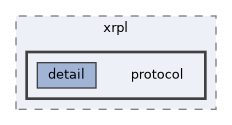
Directories | |
| detail | |
Detailed Description
protocol
Classes and functions for handling data and values associated with the XRP Ledger protocol.
Serialized Objects
Objects transmitted over the network must be serialized into a canonical format. The prefix "ST" refers to classes that deal with the serialized format.
The term "Tx" or "tx" is an abbreviation for "Transaction", a commonly occurring object type.
Optional Fields
Our serialized fields have some "type magic" to make optional fields easier to read:
- The operation x[sfFoo] means "return the value of 'Foo' if it exists, or the default value if it doesn't."
- The operation x[~sfFoo] means "return the value of 'Foo'
if it exists, or nothing if it doesn't." This usage of the tilde/bitwise NOT operator is not standard outside of the xrpld codebase.
- As a consequence of this, x[~sfFoo] = y[~sfFoo] assigns the value of Foo from y to x, including omitting Foo from x if it doesn't exist in y.
Typically, for things that are guaranteed to exist, you use x[sfFoo] and avoid having to deal with a container that may or may not hold a value. For things not guaranteed to exist, you use x[~sfFoo] because you want such a container. It avoids having to look something up twice, once just to see if it exists and a second time to get/set its value. (Real example)
The source of this "type magic" is in SField.h.
Related Resources
Generated by
 1.17.0