docker Directory Reference
Directory dependency graph for docker:
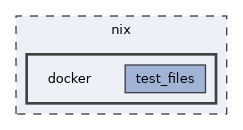
Directories | |
| test_files | |
Detailed Description
Nix CI Docker images
This directory builds the Docker images used by xrpld's Linux CI. Each image bundles the exact same toolchain that the Nix development shell provides (see docs/build/nix.md), so what runs in CI matches what developers get locally from nix develop.
The toolchain (CMake, Ninja, Conan, GCC, Clang, clang-tidy, the sanitizer/coverage tools, …) is defined in nix/packages.nix and assembled for CI by nix/ci-env.nix. The Docker build turns that Nix environment into an ordinary container image layered on top of a conventional base image (Ubuntu, Debian, RHEL, or nixos/nix).
Images
The images are built by the build-nix-images.yml workflow and pushed to ghcr.io/xrplf/xrpld/nix-<distro>. The <distro> is selected through the BASE_IMAGE build argument; the base images are the oldest supported version of each distribution we target:
| Image | BASE_IMAGE | Notes |
|---|---|---|
| nix-nixos | nixos/nix:latest | Build/lint only; binaries are not run (see below). |
| nix-ubuntu | ubuntu:20.04 | Oldest supported Ubuntu (glibc 2.31). |
| nix-debian | debian:bookworm | |
| nix-rhel | registry.access.redhat.com/ubi9/ubi:latest |
All images carry the full toolchain on PATH (via /nix/ci-env/bin) plus the CA bundle shipped in the Nix environment, so HTTPS clients (git, curl, Conan) work without ca-certificates being installed in the base image.
Build stages
Dockerfile is a multi-stage build:
- builder — On a nixos/nix builder, evaluate the flake and build the CI environment (nix/ci-env.nix). The resulting Nix store closure (the complete set of store paths the toolchain depends on) is copied into a staging directory.
- final — Start from BASE_IMAGE, copy in the Nix store closure and the ci-env symlink tree, and wire up PATH and the CA bundle. It then:
- installs the dynamic linker if the base image lacks one (see How libc is handledHow libc is handled
),
- runs bin/check-tools.sh to verify every expected tool is present and runnable.
- compiles the C++ test programs in test_files/cpp/sources/ with both g++ and clang++, and sanitizers, and
- compiles the Rust test programs in test_files/rust/sources/ with rustc, and builds the test_files/rust/proc_macro/ workspace with cargo to exercise proc-macro dylib loading.
tester — Start again from a clean BASE_IMAGE (no Nix toolchain), install only the sanitizer runtime libraries (install-sanitizer-libs.sh), and run the binaries compiled in final. This proves the binaries built with the Nix toolchain actually run on a vanilla base image. On nixos/nix this step is skipped (the binaries are patched for a conventional FHS loader).
- Output — The final image is gated on the tester succeeding: it copies a sentinel file out of tester, so a failed test run fails the whole build.
How libc is handled
The goal is for binaries built in these images to run on the oldest supported base image (Ubuntu 20.04, glibc 2.31) and newer — without the developer's Nix toolchain being present at runtime. Two pieces make that work:
- Compilers linked against an old glibc. The Nix CI environment does not use nixpkgs' current glibc. Instead it pins a 2020 nixpkgs snapshot whose primary glibc is 2.31 (matching Ubuntu 20.04), via the nixpkgs-custom-glibc flake input. GCC, Clang, binutils and compiler-rt are all rebuilt/wrapped against this custom glibc (see nix/ci-env.nix). As a result the libraries they emit (libstdc++, libgcc_s, the sanitizer runtimes) reference only symbols available in glibc 2.31.
- An expected dynamic linker in the image. Binaries built in Nix environments reference a dynamic linker from Nix store paths, which won't be present in the base image. However, bin/default-loader-path.sh reports the expected loader path for the current architecture, so we can patch the binaries to use the correct loader.
The build then verifies all of this end to end, and the C++ and Rust programs go through the same pipeline: each is compiled in final, has its PT_INTERP patched to the target loader, and is then run in the clean tester stage to confirm it emits the expected diagnostic on a stock base image. The C++ programs are in test_files/cpp/sources/ (a regular binary plus ASan/TSan/UBSan variants); the Rust programs are in test_files/rust/sources/ (a hello binary plus panic and overflow-check variants), plus the test_files/rust/proc_macro/ workspace — a crate whose compilation additionally loads a proc-macro dylib, and whose resulting binary is patched and run like the others.
Files
| File | Purpose |
|---|---|
| ./Dockerfile | Multi-stage build described above. |
| ./test_files/cpp/ | C++ sanitizer smoke test: sources + compile/run scripts. |
| ./test_files/rust/ | Rust smoke test: rustc sources + a cargo proc-macro workspace + compile/run scripts. |
| /bin/check-tools.sh | Verify every expected tools are present and runnable. |
| /bin/default-loader-path.sh | Print the dynamic-linker (PT_INTERP) path for the current architecture. |
| /bin/install-sanitizer-libs.sh | Install libasan/libtsan/libubsan runtimes on the supported base images. |
Generated by
 1.17.0