xrpl::test::BufferTest Struct Reference
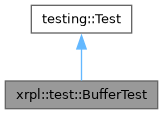
Inheritance diagram for xrpl::test::BufferTest:
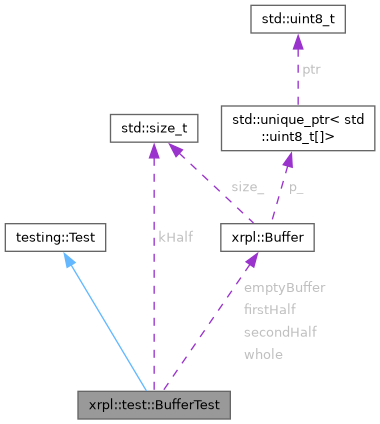
Collaboration diagram for xrpl::test::BufferTest:
Static Public Member Functions | |
| static bool | sane (Buffer const &b) |
| static void | checkEmptyAfterMove (Buffer const &buf) |
| Check the state Buffer documents for a moved-from buffer: "the other buffer is reset", i.e. | |
Public Attributes | |
| Buffer const | emptyBuffer |
| Buffer const | firstHalf {kRandomData.data(), kHalf} |
| Buffer const | secondHalf {kRandomData.data() + kHalf, kHalf} |
| Buffer const | whole {kRandomData.data(), kRandomData.size()} |
Static Public Attributes | |
| static constexpr auto | kRandomData |
| static constexpr std::size_t | kHalf = kRandomData.size() / 2 |
Detailed Description
Definition at line 19 of file Buffer.cpp.
Member Function Documentation
◆ sane()
|
static |
Definition at line 29 of file Buffer.cpp.
◆ checkEmptyAfterMove()
|
static |
Check the state Buffer documents for a moved-from buffer: "the other buffer is reset", i.e.
empty and sane.
Zeroing the size is not incidental tidiness. Moving the member unique_ptr nulls the data pointer whether Buffer wants it or not, so a moved-from buffer that kept its old size would lie about itself everywhere: alloc() would take its n == size_ early-out and hand back a null pointer while still reporting the old size, fill() would run std::fill_n over a null pointer, and the Slice conversion would publish {nullptr, oldSize} to callers. A moved-from Buffer has to be a usable empty Buffer rather than a landmine, which is why the tests below assert this state instead of treating a moved-from buffer as untouchable.
Definition at line 50 of file Buffer.cpp.
Member Data Documentation
◆ kRandomData
|
staticconstexpr |
Initial value:
= std::to_array<std::uint8_t>(
{0xa8, 0xa1, 0x38, 0x45, 0x23, 0xec, 0xe4, 0x23, 0x71, 0x6d, 0x2a,
0x18, 0xb4, 0x70, 0xcb, 0xf5, 0xac, 0x2d, 0x89, 0x4d, 0x19, 0x9c,
0xf0, 0x2c, 0x15, 0xd1, 0xf9, 0x9b, 0x66, 0xd2, 0x30, 0xd3})
Definition at line 21 of file Buffer.cpp.
◆ kHalf
|
staticconstexpr |
Definition at line 26 of file Buffer.cpp.
◆ emptyBuffer
| Buffer const xrpl::test::BufferTest::emptyBuffer |
Definition at line 56 of file Buffer.cpp.
◆ firstHalf
Definition at line 57 of file Buffer.cpp.
◆ secondHalf
Definition at line 58 of file Buffer.cpp.
◆ whole
| Buffer const xrpl::test::BufferTest::whole {kRandomData.data(), kRandomData.size()} |
Definition at line 59 of file Buffer.cpp.
Generated by
 1.17.0